Fertility Supplements Australia: The Complete Guide for Women Trying to Conceive


Fertility Supplements Australia: The Complete Guide for Women Trying to Conceive
For Australian women navigating the path to parenthood, fertility supplements have become an increasingly central part of pre-conception planning. With the right nutritional foundation, your body is better equipped to produce healthy eggs, regulate ovulation, and sustain early pregnancy. This guide covers the most evidence-supported fertility supplements available in Australia in 2026 — what they do, what the research says, and why Conceive Plus has become the trusted choice of thousands of Australian couples.
Why Fertility Supplements Matter for Australian Women
Australia's geographic advantages — ample sunshine and access to fresh produce — might suggest that nutritional deficiencies should be rare. The reality is more complex. Despite abundant sunlight, vitamin D deficiency affects an estimated 30% of Australians due to sun-avoidance behaviour, high sunscreen use, and indoor work lifestyles. Among women of reproductive age with darker skin tones or limited outdoor exposure, deficiency rates are even higher.
Similarly, dietary patterns in Australia have shifted significantly toward processed foods over the past two decades. A 2022 analysis published in Nutrients found that Australian women of reproductive age commonly fall short of recommended intakes for folate, iron, iodine, and omega-3 fatty acids — all nutrients with direct implications for fertility and early pregnancy outcomes.
The Australian Institute of Health and Welfare (AIHW) reports that approximately 1 in 6 Australian couples experience infertility, with nutritional factors playing a contributing role in a meaningful proportion of cases. Targeted fertility supplementation addresses these gaps, supporting the biological processes — egg maturation, ovulation, fertilisation, and implantation — that must occur for conception to succeed.
Folate vs Folic Acid: What Australian Fertility Specialists Recommend
Folate is universally recognised as the most important nutrient for women planning pregnancy. The Royal Australian and New Zealand College of Obstetricians and Gynaecologists (RANZCOG) recommends that all women planning pregnancy begin folate supplementation at least one month before conception, with most fertility specialists recommending a three-month lead time to ensure adequate levels.
The critical distinction that is now widely understood in the Australian medical community is the difference between synthetic folic acid and active methylfolate (5-MTHF). Approximately 40% of women carry variants of the MTHFR gene that reduce their ability to convert folic acid into the active form their bodies can actually use. For these women, standard folic acid supplements may be significantly less effective, and methylfolate supplementation is recommended.
Testing for MTHFR variants is available through Australian pathology services and increasingly requested by GPs managing pre-conception care. However, even without testing, choosing a fertility supplement that uses methylfolate rather than folic acid represents a sensible precaution that ensures effectiveness regardless of genetic status. Conceive Plus fertility supplements use methylfolate at the recommended pre-conception dosage.
Iodine: The Australian-Specific Fertility Consideration
Iodine deficiency is a particular concern for Australian women, reflecting the historically low iodine content of Australian soils. The National Health and Medical Research Council (NHMRC) identifies iodine deficiency as an ongoing public health concern in Australia, with several states and territories classified as mildly iodine-deficient.
Iodine is essential for thyroid hormone production, and thyroid function has profound effects on fertility. Subclinical hypothyroidism — often caused or exacerbated by iodine insufficiency — is associated with longer time to conception, increased miscarriage risk, and reduced IVF success rates. A 2021 Australian study published in the Medical Journal of Australia found that iodine supplementation in mildly deficient women improved thyroid function parameters and was associated with better ovarian reserve markers.
RANZCOG recommends 150 mcg of iodine daily for women planning pregnancy or breastfeeding. High-quality fertility supplements for Australian women should include iodine in this range, as most Australian dietary sources alone are insufficient to meet this target. This is a nutrient often absent from supplements marketed in other countries but essential for the Australian context.
Trusted by Australian couples trying to conceive. Conceive Plus fertility supplements and fertility-friendly lubricant are available in Australia — formulated with the nutrients that matter most for conception. Shop Conceive Plus Australia now →
CoQ10 for Egg Quality: The Supplement Australian Fertility Clinics Recommend
Coenzyme Q10 has become one of the most commonly discussed fertility supplements in Australian reproductive medicine, and with good reason. CoQ10 is a mitochondrial cofactor that fuels the energy demands of egg maturation — a process requiring enormous cellular energy that declines as women age.
Major Australian fertility clinics — including Melbourne IVF, Monash IVF, and City Fertility — have adopted pre-IVF supplementation protocols that commonly include CoQ10 at 400–600 mg daily, typically begun 60–90 days before egg retrieval. The clinical rationale is supported by multiple randomised controlled trials, including a landmark study demonstrating that CoQ10 supplementation significantly improved the number of mature eggs retrieved, fertilisation rates, and embryo quality in women over 35.
For women pursuing natural conception, the egg quality benefits of CoQ10 are equally relevant. Chromosomally normal eggs — which CoQ10 helps support through improved mitochondrial function — are more likely to fertilise successfully, implant, and develop into healthy pregnancies. The optimal supplementation window of 90 days aligns with the full egg maturation cycle, making early supplementation critical.
The ubiquinol form (the active, reduced form of CoQ10) demonstrates superior bioavailability compared to the more common ubiquinone form, particularly in women over 35. Conceive Plus fertility supplements include CoQ10 in the ubiquinol form to ensure maximum therapeutic benefit.
Vitamin D3 and Omega-3s: Addressing Common Australian Deficiencies in Fertility
Despite Australia's reputation as a sun-drenched country, vitamin D deficiency is surprisingly prevalent. Urban lifestyles, high sunscreen use, and indoor work environments mean that many Australian women — particularly in southern states and during winter months — are not producing adequate vitamin D through sun exposure alone.
Vitamin D's role in fertility is multifaceted and increasingly well-documented. Research from the University of Queensland found that vitamin D receptor expression in the ovaries, endometrium, and fallopian tubes directly influences ovarian function, endometrial receptivity, and implantation. Women with vitamin D deficiency (serum 25-OH-D below 50 nmol/L, a threshold common in southern Australia) had significantly lower conception rates in both natural and assisted conception cycles.
Omega-3 fatty acids — particularly DHA and EPA from marine sources — address another common gap in the Australian diet despite the country's coastal culture. A 2023 study in the Journal of Lipid Research found that women in the highest quartile of DHA intake had a 26% higher probability of live birth per IVF cycle. For natural conception, omega-3s reduce systemic inflammation — a key driver of endometriosis and PCOS — and support the production of prostaglandins that facilitate ovulation and implantation.
Iron and B12: Preventing Deficiencies That Impair Ovulation
Iron deficiency anaemia affects approximately 12–15% of Australian women of reproductive age, with higher rates among vegetarians, vegans, and women with heavy menstrual periods. Beyond the well-known systemic effects of anaemia, iron deficiency specifically impairs ovulation — a connection that has been consistently demonstrated in epidemiological research.
The landmark Harvard Nurses' Health Study found that women taking supplemental non-haem iron were 40% less likely to experience ovulatory infertility compared to non-supplementers, after controlling for confounders. This relationship persisted across a broad range of iron intake, suggesting that optimising iron stores — not just avoiding clinical anaemia — improves ovulatory function.
Vitamin B12 deficiency, while less common than iron deficiency, has significant implications for fertility and early pregnancy. B12 is essential for DNA methylation, cell division, and the conversion of homocysteine to methionine. Elevated homocysteine — a marker of B12 (and folate) insufficiency — is associated with poor egg quality, embryo development failure, and increased miscarriage risk. Vegans and vegetarians are at particular risk of B12 deficiency and should ensure their fertility supplement includes B12 in the methylcobalamin form.
Timing, Consistency, and Combining Supplements with a Fertility Lubricant
The most important principle of fertility supplementation is consistency over the 90-day egg maturation window. The biological processes that determine egg quality — mitochondrial biogenesis, DNA repair, chromosomal segregation — are ongoing throughout follicle development. Irregular supplementation significantly reduces the cumulative benefit.
Australian fertility dietitians and naturopaths commonly recommend taking fertility supplements with the largest meal of the day to optimise absorption of fat-soluble vitamins (A, D, E, K) and CoQ10. B vitamins and iron are best taken in the morning to minimise sleep disruption from their energising effects.
Complementing a fertility supplement protocol with a sperm-friendly lubricant is recommended by many Australian fertility specialists, particularly for couples who experience vaginal dryness during fertile window intercourse — a common issue caused by antihistamines, antidepressants, dehydration, or simply the timing of intercourse. Standard lubricants available in Australian supermarkets and pharmacies have been shown to significantly reduce sperm motility and should be avoided when trying to conceive.
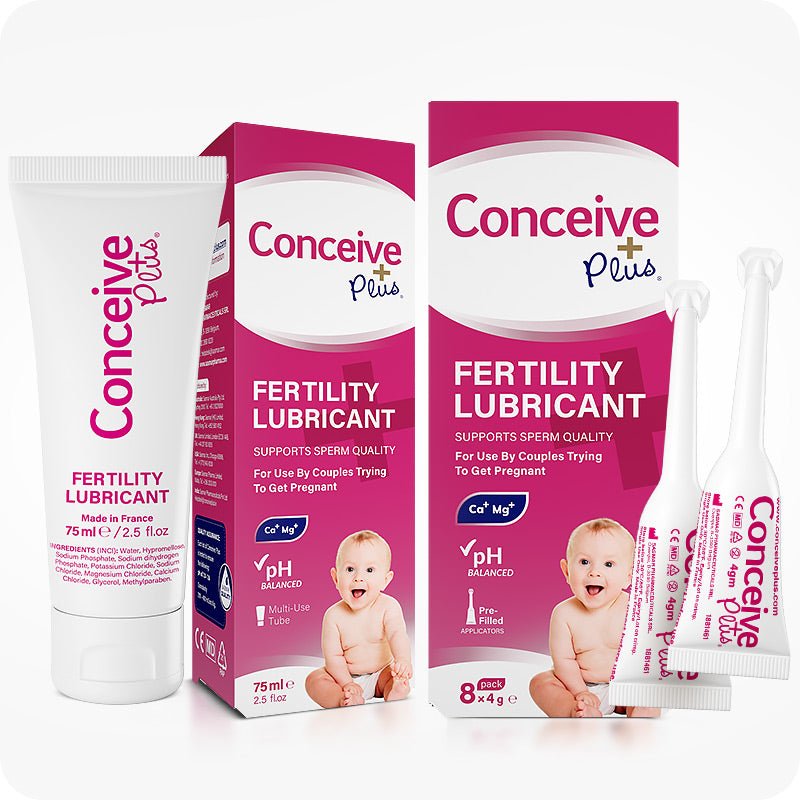
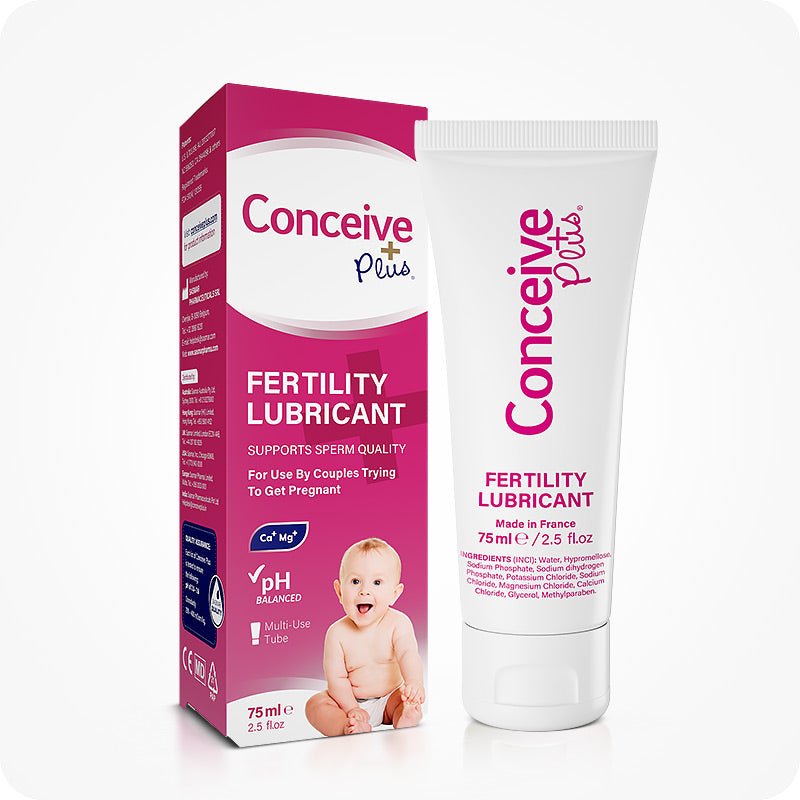
Conceive Plus fertility lubricant is formulated to match the physiological properties of fertile cervical mucus — pH-balanced between 7.2 and 8.5, isotonic to human tissue, and enriched with the calcium and magnesium ions that support sperm capacitation. It is available across Australia and trusted by fertility specialists as the sperm-safe lubricant of choice.
FAQ: Fertility Supplements Australia
What fertility supplements do Australian fertility specialists recommend?
Australian fertility specialists commonly recommend methylfolate (not synthetic folic acid), CoQ10 (ubiquinol form), vitamin D3, omega-3 DHA, iodine, iron, and myo-inositol. The specific protocol depends on individual factors including age, cycle regularity, and any diagnosed conditions.
How long should I take fertility supplements before trying to conceive in Australia?
RANZCOG and most Australian fertility specialists recommend starting at least 3 months before actively trying to conceive. This allows the full 90-day egg maturation cycle to benefit from supplementation. For women over 35 or with known conditions, starting earlier provides additional benefit.
Is vitamin D deficiency a concern for fertility in Australia?
Yes, significantly. Despite Australia's sunshine, vitamin D deficiency affects approximately 30% of Australians due to sun-avoidance behaviours and indoor lifestyles. Vitamin D deficiency is directly associated with reduced conception rates, poor egg quality, and lower IVF success rates. Supplementation with 2,000–4,000 IU of vitamin D3 daily is commonly recommended for women TTC.
Why is iodine important for fertility in Australia?
Australian soils have historically low iodine content, making dietary iodine intake suboptimal for many Australians. Iodine is essential for thyroid hormone production, and thyroid dysfunction directly impairs fertility and increases miscarriage risk. The NHMRC recommends 150 mcg iodine daily for women planning pregnancy.
Can I get fertility supplements on the PBS or Medicare in Australia?
Over-the-counter fertility supplements are not subsidised through the PBS or Medicare. However, if your GP identifies specific deficiencies through blood tests (e.g., vitamin D, iron, B12), therapeutic doses may be prescribed and may attract PBS subsidy. Speak to your GP about testing before TTC.
Are Conceive Plus products available in Australia?
Yes. Conceive Plus fertility supplements and fertility lubricant are available for purchase online in Australia through the Conceive Plus Australia website, with delivery across all states and territories.
What is the best fertility supplement for women over 35 in Australia?
For women over 35, CoQ10 (ubiquinol form, 400–600 mg daily) is a priority addition alongside the standard fertility supplement protocol. CoQ10 addresses the age-related mitochondrial decline that affects egg quality, with the strongest evidence base of any supplement for this population. Conceive Plus women's fertility supplements include CoQ10 alongside methylfolate, vitamin D3, and other key nutrients.
Should my partner also take fertility supplements?
Yes, male fertility supplementation is equally important. Sperm quality is a contributing factor in approximately 50% of infertility cases. Male fertility supplements typically include zinc, selenium, CoQ10, vitamin C, vitamin E, and L-carnitine — nutrients with strong evidence for improving sperm count, motility, and morphology. Conceive Plus makes a dedicated men's fertility supplement for this purpose.
Give your fertility the nutritional support it deserves. Conceive Plus fertility supplements are formulated with methylfolate, CoQ10, vitamin D3, iodine, and a complete micronutrient blend — everything Australian women need when trying to conceive. Shop Conceive Plus Australia →